Music instruments that were (and are still) most commonly used in Breton music were bombard, biniou (breton bagpipe), treujenn gaol, (actually a clarinet), accordion.
Bombard (left) and biniou (right), mostly played together
More recently (i.e. in the 70’s and after World War II), new instruments like guitars, Irish wooden flute, bass, violin, Scottish bagpipes were introduced.
Treujenn Gaol (Breton clarinet)
In Astrakan Project, I mostly play stringed instruments. You may have noticed that I use guitar, but also Turkish ‘ud and bağlama (commonly called saz in western Europe). One may think this is to give an oriental flavour to our music. This might be partly true, but I don’t think this is the main reason.
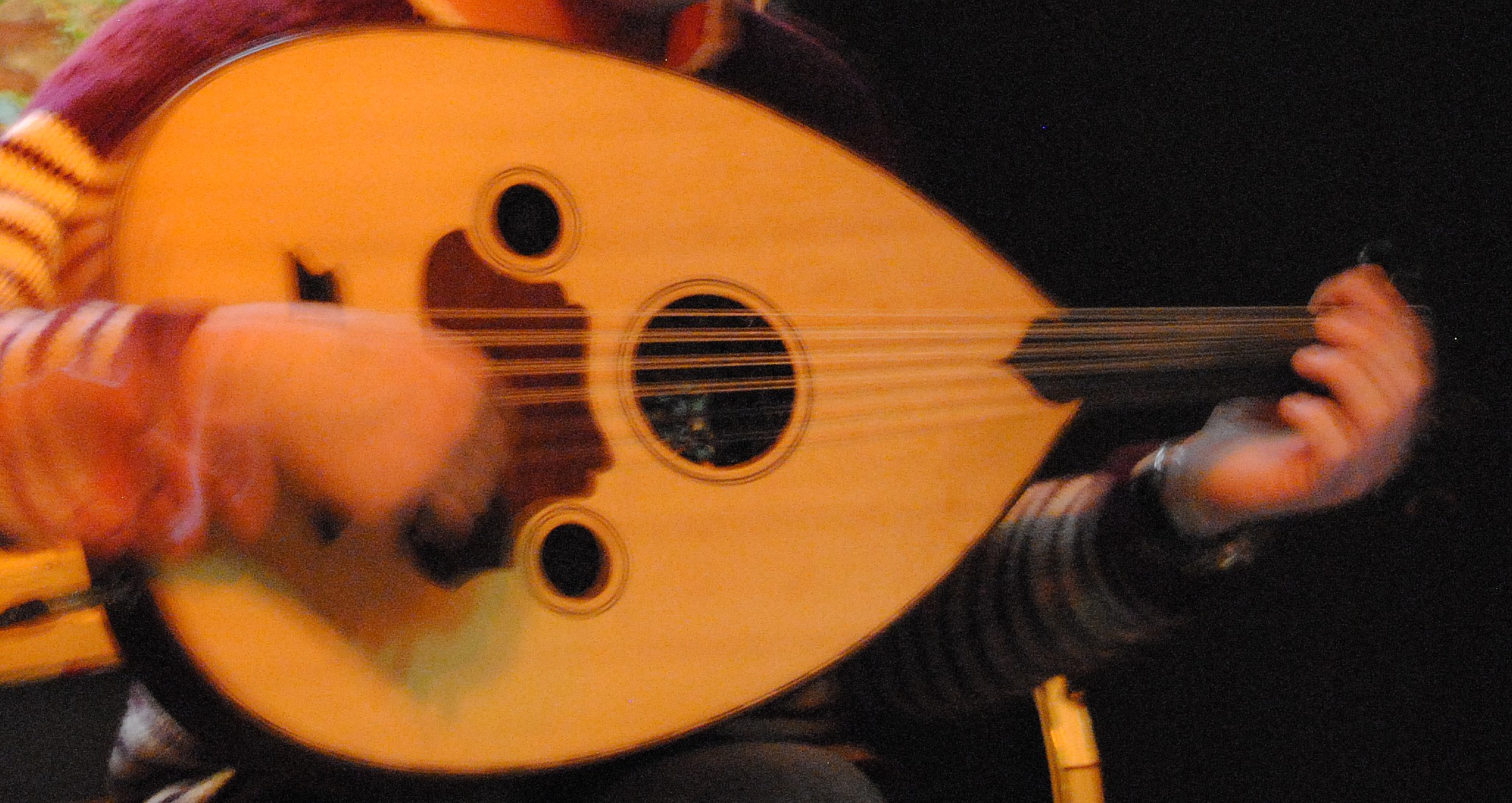
‘ud
One good reason is of course the fact that we currently live in Turkey, where ‘ud and bağlama are commonly used, so why shouldn’t I use them, temptation is so huge ?
But another good reason is that these instruments enables to play “more notes”, including the so called “commas“. In Breton music, we do have “commas” (see here for further explanations, for musicologists only !), yes, but they tend to disappear with the introduction of guitar, accordion and Scottish bagpipes for instance. You can play any note you want on a ‘ud, and almost any on a bağlama (even if there are frets).
Bağlama
When I play a breton tune, I feel closer to the truth (?) when I use the ‘ud than when I use the guitar, I think that’s a good reason for using oriental instruments !
§ Yann
41.00527028.976960
Your friends might thank you for letting them know about our music !
We get asked quite often WHY we chose to sing Breton songs in the Breton language (indeed, some traditional songs from Brittany are also in French).
Actually, we never chose, it just happened that our music’ lyrics are in Breton. Of course, we could explain why we prefer songs in Breton, because of the rhythm of the language, maybe also because of the particular sounds, because of the stories, but explanations came out afterwards.
Don’t give up…
The question should maybe then be “why do you KEEP singing in Breton when such a few amount of people may be able to understand you?”. This issue is for sure a meaningful one for us. None of us was brought up in Breton, in my case, because my family is not from Brittany, in Yann’s case, just like… more than probably 99% of people that are our age. In a survey made in 1997, 0.2% of people aged from 15 till 19 were able to speak Breton (source) . People our age.
We have both a good knowledge of Breton, from self study, from paying attention to songs, to road signs, from trying to speak to old people, from night classes… But anyone having learned any foreign language for a couple of years knows how hard it is to make it your language. Despite of that, we both strangely relate to that language as being our language. The one we’re emotionally connected with.
We don’t sing in Breton to be understood. Nor to be heroic people trying to save their language. We sing in Breton because it is a part of us. We sing in Breton because it is what we like to do. But when we sing in Breton, deep in our heart, you’ll find sorrow, because we know that not many people will understand all the beauty behind the poetry, we know that no translation or explanation can replace it.
§ Simone
41.00527028.976960
Your friends might thank you for letting them know about our music !
Do you wanna try something ? Listen one more time to Tri Martolod …
… and try to concentrate on the percussions you hear right on the beginning, when the ‘oud starts to play. What does it make you think about ? any idea what it could be ? The answer is in this short video :
Which lead us to something as musicians we know but is still hard to admit : music is not only about expensive materials and instruments. We know it. But sometimes it’s more comfortable to hide behind a brand, or any accessory. Not that they are not useful, they are, they also add value, but music is more than that.
what else
Yann got inspired for this sound while queuing at the local grocery store and thinking about this Turkish song :
Can you believe Yann heard this song for the first time last winter ?
§ Simone
41.00527028.976960
Your friends might thank you for letting them know about our music !
Starting a fresh new year is always the right time to :
start new things, and we’re already working on some new tunes and songs
look back toward what we did in the previous year.
And this how we thought that it was time to do something with some rather good quality recordings we had from our concert in Beirut last spring, so we put them on Bandcamp, and they’re available for download, all together or separately, you can listen to them before, decide to pay something for them or even get them for free, and please : feel free to share them around !
§ Simone
41.00527028.976960
Your friends might thank you for letting them know about our music !
As we use a computer with pre-recorded loops on stage (this post), we realised that we needed (and that we still need !) to find the right balance between those two following extreme situations:
A : The computer only provides very simple loops such as a drone or a basic beat.
B : The computer provides the full set of missing instruments so that we play the songs as they can be heard from the album. B-statement in our minds is this :
I must say that when I had started loop programming, we were first very close to the A-statement. Later on, as I was thinking that my programming skills and experience were increasing, we got very close to the B-statement…
The kind of music we would like to play on stage is somewhere in-between. A-statement may not be sufficient since we are in most cases only two musicians on stage (Voice and stringed instrument, except when we have guests), whereas B gives the feeling that we are not really playing but that the laptop is playing for us. Some would call this “Karaoke” !
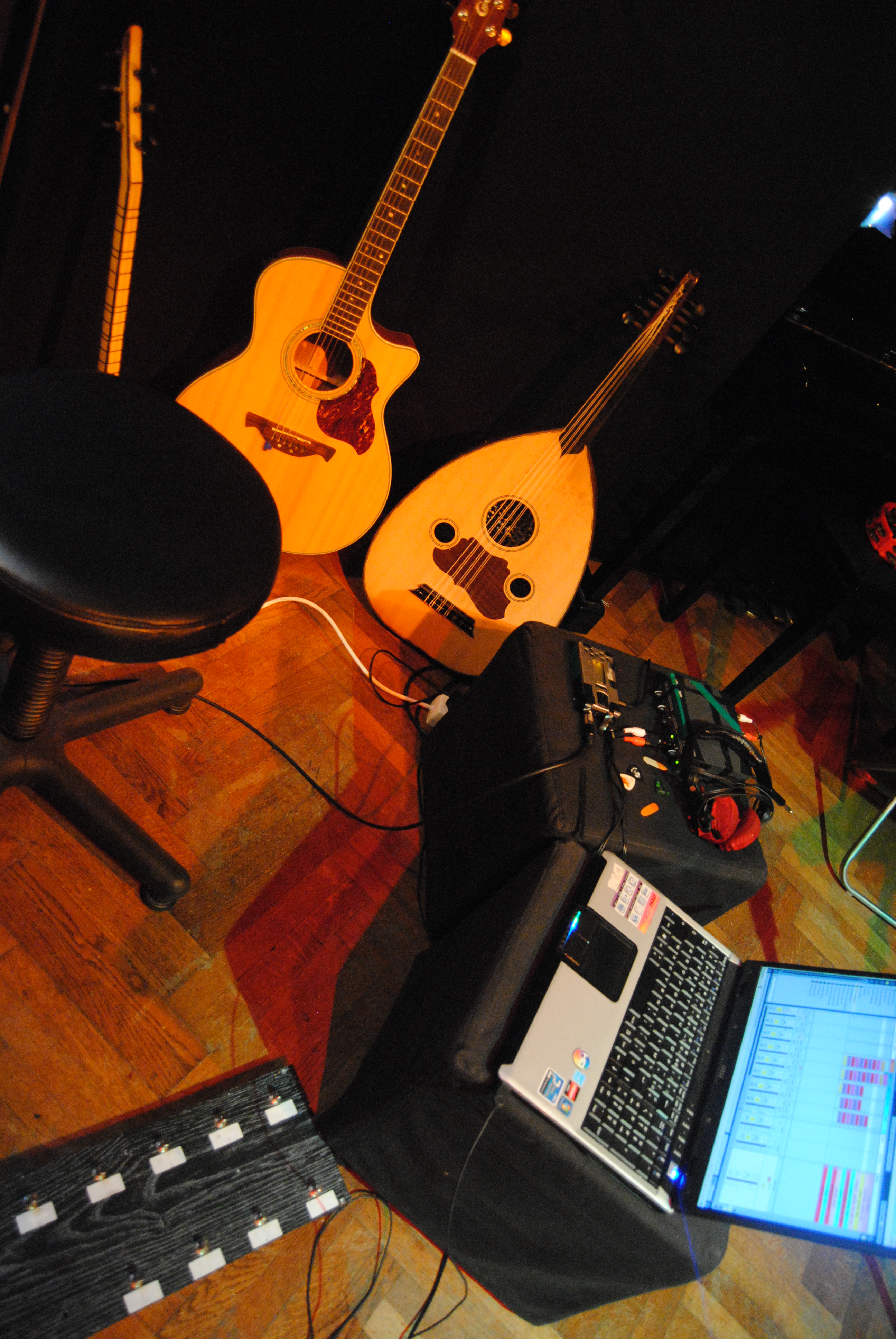
Our laptop, footswitch and instruments
So, we’re going back to A, but not as close as in the beginning, loops mostly consisting in drones and light rhythms. We do hope we’re on the way to find the right balance !
[ yann ]
41.00527028.976960
Your friends might thank you for letting them know about our music !
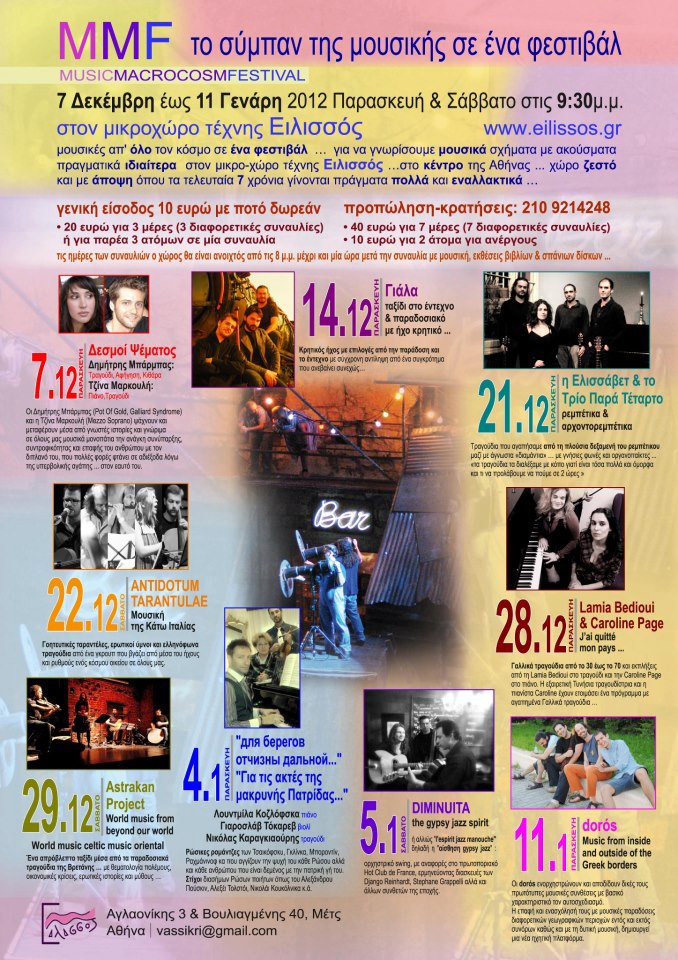
A couple of pictures from our nice evening in Eilissos for Music Macrocosm Festival. We loved Athens, its relaxed ambiance, the beautiful winter light ever the Acropolis, its generous food… and we really had a nice time with a very enthusiastic and warm audience, and we surely wish we’ll have a chance to play again in Greece.
41.00527028.976960
Your friends might thank you for letting them know about our music !
We are happy to welcome a great singer as a guest for our coming concert in Athens : Lamia Bedioui. We always feel surprised when we realise that musics that come from different cultures from different parts of the world can sometimes be so close to each other.
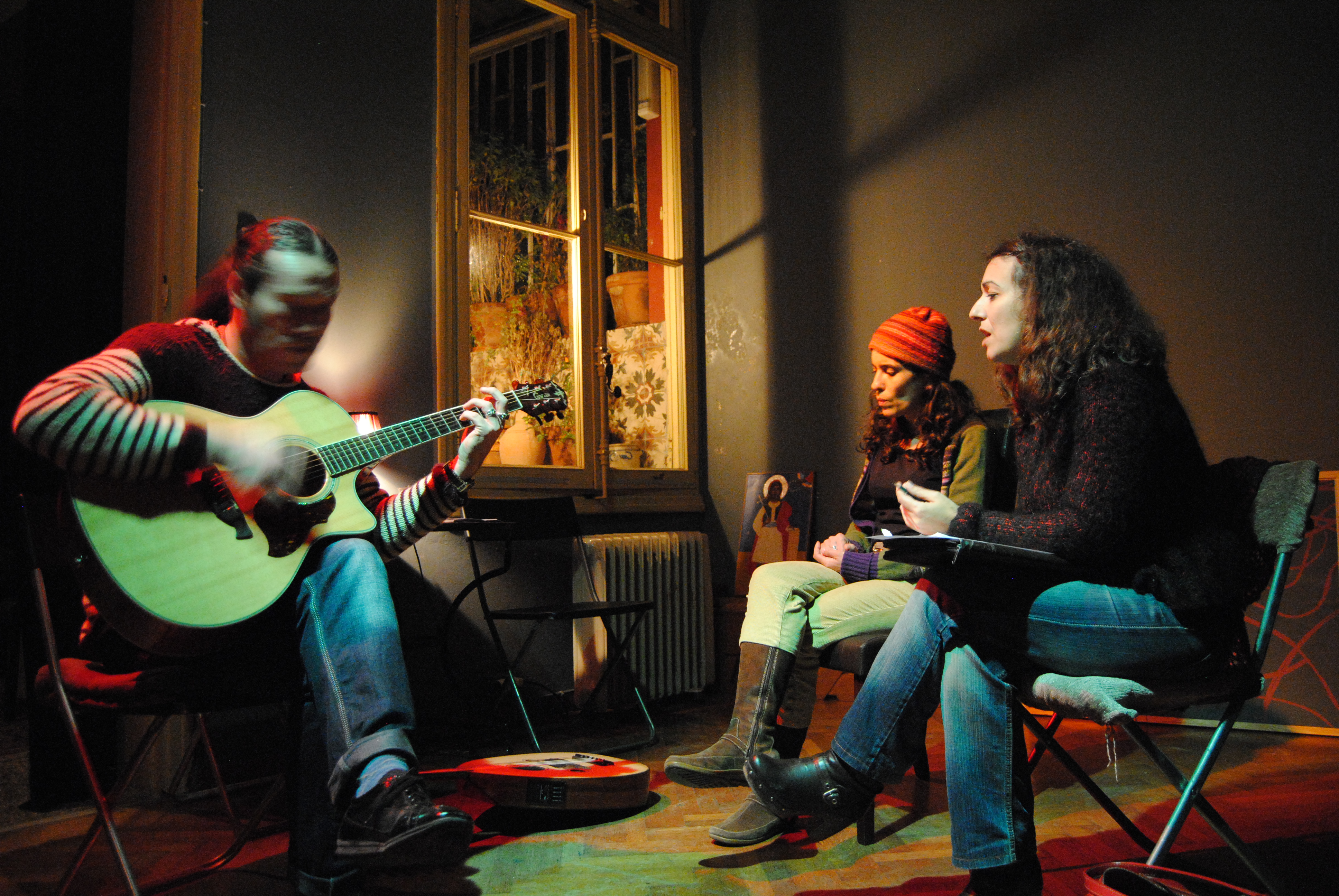
Rehearsal in Athens with Lamia Bedioui – Picture : Δέσποινα Μπετείνη
Thanks to her for joining us !
41.00527028.976960
Your friends might thank you for letting them know about our music !
When using softwares like Ableton Live on stage, with not such a powerful laptop and a cheap soundcard, the problem is that the output instrument sounds come out with a time delay of a few ms, which can be quite uncomfortable when playing on stage.
I use this unwanted delay as a stereo effect for the stringed instruments by a very simple trick :
Instrument signal enters the soundcard by the left side. I use the direct stereo monitoring, which means that direct instrument sound is sent to the left output. Then in Ableton Live, I send all the instrument output to the right side, but it will be heard with a little time delay.
This gives a very interesting stereo effect that makes the instrument sound out clearer among the loops.
[ yann ]
41.00527028.976960
Your friends might thank you for letting them know about our music !
It is commonly known that professional studio recordings are made using 24-bit depth and sometimes 192kHz sampling frequency. But records that are on a CD are only 16-bit and 44.1kHz which enables a sound quality that is already far above what human ear can feel.
But then our question was :
Why the hell are they using 24-bit/192kHz although 16-bit/44.1kHz is what we use for a CD ? The answer is rather simple : when processing tools are used (such as compression or reverb for example during the mix and also during the final mastering process), low bit depth and low sample frequencies result in lower sound quality after the processing, for a simple reason : numerical errors that occur during the computations (because numerical data use a finite number of digits) get more amplified as the processing chain gets longer. Therefore it is strongly advised to record and process using the highest bit depth and sampling frequency as possible, and to convert the final result to 16/44.1 before burning the master.
But this means several requirements :
Much larger amount of memory
More powerful computers and stuff to handle this
High quality and expensive monitors (they can be very expensive !)
As a conclusion : much more money !
And what we do have :
In our case, we have a very cheap USB soundcard (E-MU tracker pre, about 100€), Behringer MS40 monitors (among the cheapest monitors ever, around 200€), and a laptop (a PC, not even a Mac which means no firewire) with 2GHz AMD Athlon Dual Core and 4GB RAM.
The voice and the stringed instruments were recorded with a Behringer B-1 microphone that we bought for 70€ in Portugal. We also used a Korg Pandora ToneWorks for the stringed instruments effects (Compression, chorus, flanger, distorsion etc…) that we got almost for free from my previous guitar teacher some years ago. The percussions were recorded both with this B-1 and a basic SM58 microphone.
This is what we could call a cheap home don’t you think ?
The home studio
So our conclusion was :
First of all, we think our monitors cannot truly render the difference between 16/44.1 and 24/192.
Our sound recording skills, experience and listening accuracy may not be sufficient to be able to feel the difference (it is commonly said that a sound engineer’s ear has to be trained for at least 10 years before being fully accurate).
Most of the samples we used when setting up the pieces (i.e. snare or bass drum samples for instance) were mostly free samples collected from the internet, or even extracted from CDs, and therefore 16/44.1 samples.
The recording process was already quite advanced, and we were feeling doubts growing up in our mind.
We read somewhere that Alanis Morissette’s first CD was recorded using 16-bit…
We also realised that most people listen to mp3 music on their computer or smartphone directly from youtube or soundcloud with average loudspeakers or headphones !
Then we said, let’s keep on going with 16/44.1 and let’s really try to do our best !
Can you really feel the difference ?
[ yann ]
41.00527028.976960
Your friends might thank you for letting them know about our music !









 . astrakan project .