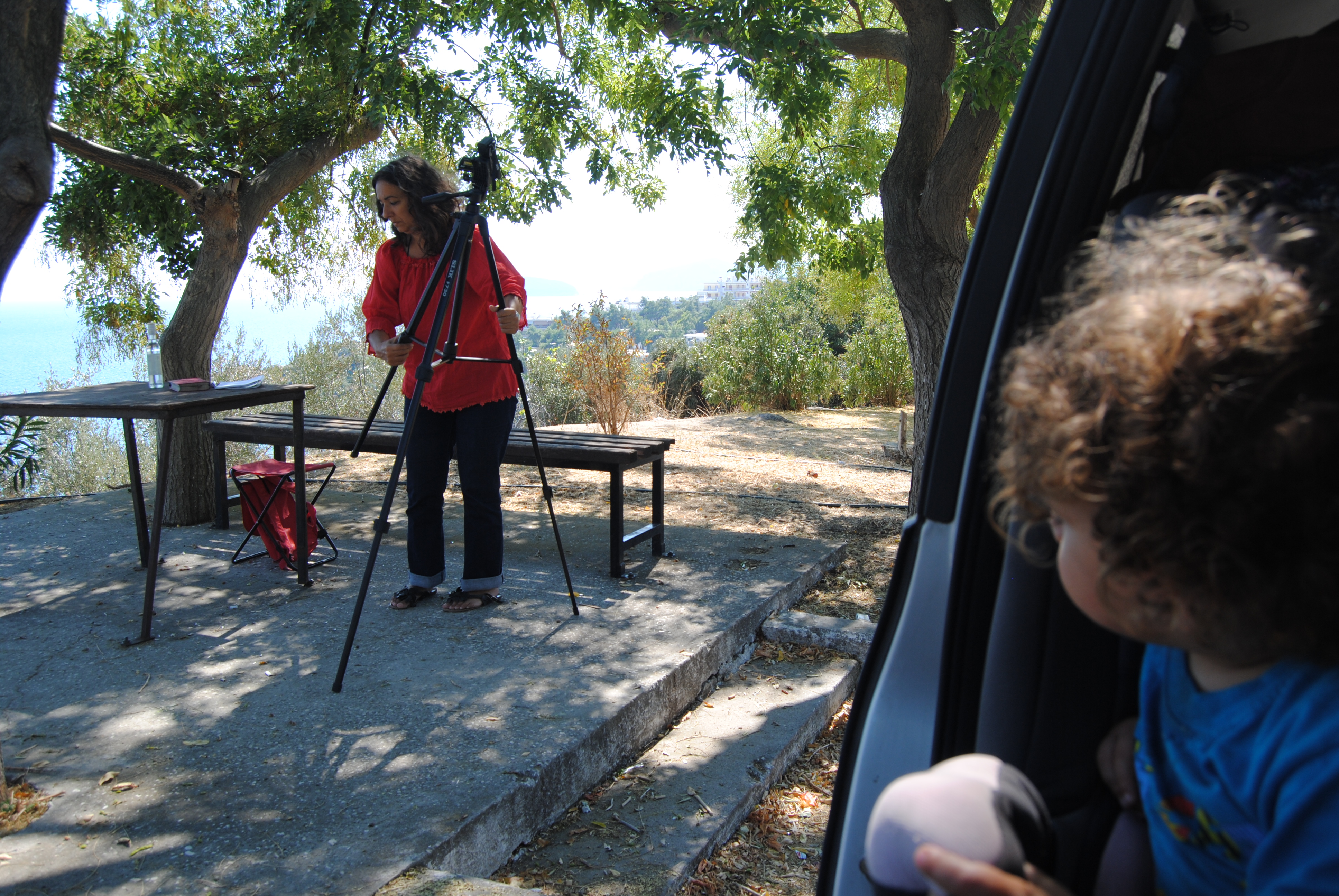
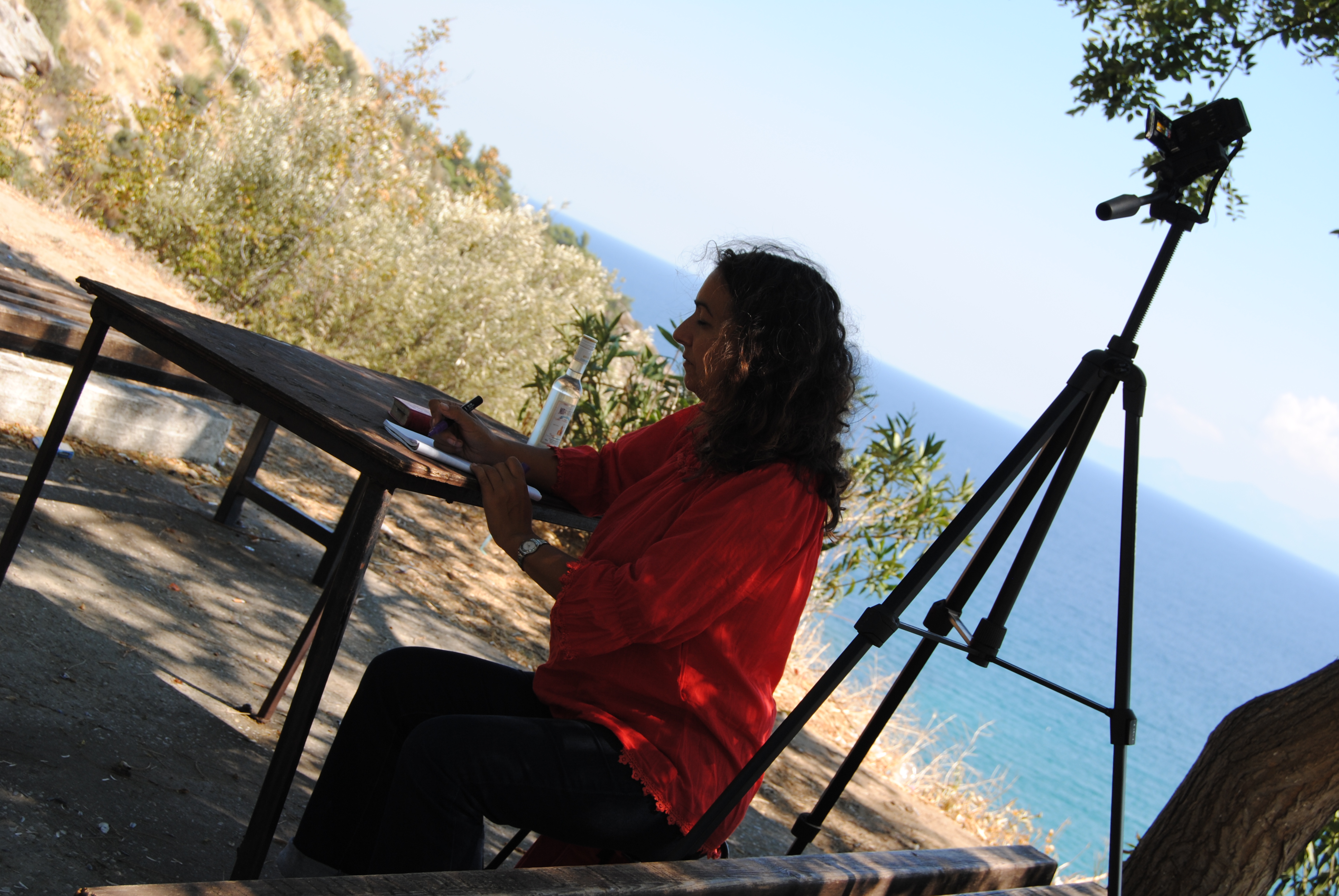
As a band, you never get enough [nice] pictures… and we took a chance to shoot a couple more while in Brittany 2 weeks ago. The shooting place is located is in our village Plougras, in an abandoned settlement, one of the buildings hosting the ghost of an old (bad & terrific) local Lord. A local pub is also opened there during the week-ends.
This slideshow requires JavaScript.
It seems that we most definitely get back to that place when we need pictures or videos, the rainy road on the “Kan Al Lagouterion” video was indeed the road between our house and this hamlet!
Our inspiration came from this kind of pictures, from wood workers in Central Brittany…
Here is the complete review we got in Songlines issue n.93 last July. We’re extremely proud to have been reviewed in such a prestigious review… and even got 4 stars **** !
Tales of dark romance and doomed love
This album has nothing, as far as one can tell, to do with the town on the Caspian Sea or hats. The core of this album is enjoyably gloomy traditional Breton singing, from the pure voice of Simone Alves with her partner Yann Gourvil in charge of instruments and programming. The duo’s songs are peppered with Celtic myth and legends, but mainly about doomed love and death. A sample lyric, translated from the Breton, as a lover decides to kill himself after his beloved dies « We’ll lie in the same grave since we haven’t in the same bed, we’ll be married in front of God since we haven’t by the priest. » What is unusual, and probably unique is the « oriental » colours added to the songs (the duo lived in Istanbul for a while) with Yann Gourvil playing oud and saz as well are more usual folk instruments.
Stand-out tracks include « 1932 », which is an effective evocation of the misery of a failed harvest when there’s no bread, while « mouezhioù » sounds a little Bulgarian and is an atmospheric song about a woman who bitterly regrets marrying a drunkard. The electronics used on songs like « Kreñv ‘veld ar garantez » are generally subtly interwoven although at time the drum machines stands out, and not in a good way. By the end of this compelling, if at times slightly claustrophobic, record there is a slight sense that some other players would have added a more rich sonic palette. Still, there are some superb songs rendered in an original way, which suggests considerable potential. The cover Art Work is intriguing too.
Track to try : 1932
Peter Culshaw
This slideshow requires JavaScript.
41.00527028.976960
Your friends might thank you for letting them know about our music !
[ lyrics, translation & facts for the last song from our album >here< ]
This song is a really really famous one, all over Brittany although it is originally from the Vannes area (>google map<). The dance itself is quite simple. The song is usually called by the 1st sentence of the lyrics, “du-hont ar ar manez““over the mountain/hills“. Indeed, the Breton word for mountain may be used for hill as well, they aren’t any huge high mountains, highest point is 380 meters (yes !) at the Mont Saint Michel de Brasparts.
This slideshow requires JavaScript.
.
Yann transformed the initial dance rhythm by adding a 7th beat. To be more technical it was a 6/4 and it was turned into 7/4.
Music & Lyrics: traditional
Instruments : acoustic & electric guitar, acoustic & electric saz
Rythme : hanter-dro dance with an extra beat
In case you had miss it, here is the video from that song that you may listen to while reading further. In case you hadn’t? Well take a chance to enjoy it once more!!!
.
.
The Vannes area has a particular Breton dialect, for linguistics lovers, the stress on the words and sentences tend to be on the last syllable, a bit like in French but unlike the other dialects from Brittany – and for non linguistics lovers, well, it does have a huge impact on the beat and the rhythm of the songs. Some words are also spelt
Du-hont, du-hont, àr ar manez ez eus ur verjelenn
Berjelenn e c’houarn he deñved a sonas ur sonenn.
On the top of the hills there’s a shepherdess While she’s taking care of her herd, she’s singing a song
Mabig ar roue he selaoue hag he selaoue mat
Na dre ar fenestr uhellañ ‘oe e palez e dad
The son of the king listen to her, and he listens well From the highest window of his dad’s castle
Sonet, sonet, berjelennig, kar me ‘gav brav ho son
O na raktal pan he c’hlevan e rejoui ma c’halon
Sing, sing young shepherdess, since I like your song , And when I hear it my heart is full of joy
Nompas, nompas, denig yaouank, me ne ganin ket ken
Kar me ‘meus ur breur en arme hag a ra din anken
Oh no, young man, I won’t sing any longer Since I have a brother gone to the army, which makes me sad
Ouian ket mard eo beuzet er mor, pe lazhet en arme
Kaset em eus un evnig rouz da c’houiet e zoare
I don’t know whether he drowned in the see or if he died at the army I’ve sent a little red bird to hear about him
Mar da ma breur ha dont en-dro me ‘vo-me begulez
Mar da ma breur ha chom en dour me ‘vo-me minourez.
If my brother is to come back I’ll have children If my brother drowns in the waters I’ll be orphan
This is as usual a personal translation, with emphasis on the meaning than on the exact-correct-official translation
§ Simone
41.00527028.976960
Your friends might thank you for letting them know about our music !
Twist en-dro is this month within >fRoots playlist<, it is time for some explanations + translations!
There is be too much to say about this odd title, en-dro means “again”, but it is also the name of a particular dance from the Vannes area. Al leur goat is a wooden generally non-permanant flooring used outside or in ballrooms for fest-noz, our favorite ones are smooth enough so that you feel lighter while dancing, but not too much either, and it responds by a sharp sound while you dance (see notes bellow from the translation…. )
Lyrics used are a very common text mostly sung as a “gavotte” like here, and know under the title “Ar Poatr Yaouank Kozh”. They are however much longer, you may find the full version >here<, with French translation.
Instruments : guitar, violin, ‘oud, electric ‘oud, derbouka
Rythme : gavotte dance
Music: a mix of traditional tunes with Yann’s compositions
[ don’t forget to click on the cover image bellow, so that you can listen to it while reading the translation… ]
Ar Poatr Yaouank Kozh
The Bachelor
Me zo chomet da goshaat ha n’on ket c’hoazh dimezet
Ha dre-se on gwelet fall gant an dimezelled
I’m getting older but I’m still not married This is why I get mocked by young Ladies
Ar merc’hed a oa gwechall a glaske labourat
Kannañ gwenn ar rochedoù, ober stamm ha gwriad
Girls used to work hard To wash, sew and repair clothes
Met ar re yaouank zo bremañ a zo o klask bezañ koant
Setu aze ‘vit petra on chomet poatr yaouank
But young ones now are trying nothing but to look pretty This is why I’m still a bachelor
Pa vo pardonioù ‘barzh ar vro, ‘hay en noz da zañsal
Neuze ‘vo klevet o c’hoarzhin hag he zreid o strakal (*)
When they are fairs around the country, they’re going at night to dance You’ll only hear laughing and their feet hitting the floor (*)
Hag an deiz war-lerc’h ‘chomo ‘pad an deiz en he gwele
Gant ar boan ba’n he divhar pe an droug ‘n he c’hostez
And then the next day they stay in bed for the all day With pain in their legs or on their stomach
Un dilhad eus ar c’haerañ ‘renko c’hoazh da gaoued
Ur robenn brodet gant seiz hag un tok alaouret
They’ll also claim for the most beautiful clothing A dress embroidered with silk and a goldish hat
An dra-se ‘vez ket gwall-bell ‘tegas ur mil da bemp kant
Setu aze ‘vit petra on chomet poatr yaouank
Before you notice it you’ll out of money
And this is why I’m still a bachelor
Notes:
(*) strakañ : hitting and making a “bang” noise all together, mostly used for the noise made by dancers feet and… like in aSTRAKAn
This is as usual a personal translation, with emphasis on the meaning than on the exact-correct-official translation
§ Simone
41.00527028.976960
Your friends might thank you for letting them know about our music !
Which means, from a linguistic point of view, it is a language, with its own own specific grammar, syntax and vocabulary, and not a dialect derived from French. Of course, it contains many words derived from French, just like French also has some words from Breton.
.
– 2 – Breton is a Celtic Language
Where French is a Latin language, Breton is from the Celtic branch of Indo-European languages, and is related to Welsh and Cornish (‘P’ Celtic languages) as well as to Irish, Scottish Gaelic and Manx (to a certain extend…).
When we look at old Cornish grammars (the last person speaking fluently the language is said to have died in 1777 – although there are groups of “neo-Cornish-speakers”), it really is very similar to modern Breton.
.
Celtic languages family
– 3 – Breton is a written language
Just because it is not an official language ( it is the only spoken Celtic language that isn’t recognised as an official or regional language), it is not taught in most schools doesn’t mean it can not be written. And indeed it has been written for centuries, The Leyde Manuscript (790) being a well-know example of old Breton.
Last official survey in 2007 indicates that 206000 people in Brittany speak Breton (out of the 4,3 Million inhabitants in the province). In 1999, 61% of them were over 60 years.
More recent sources >here< (in French, but numbers are quite easy to understand 🙂 )
.
– 5 – 14 709 children get education in Breton at school
In 2012-13, 14 709pupils (from age 3-18) get to study in Breton, within 3 systems:
Diwan: private schools with 100% teaching in Breton (except French and foreign languages)
We’ve been hardly focusing on music recently, due to all the events that are happening right now in Turkey. We’ll try to tell you soon a few personal feelings from “the inside”. In the meantime, we are proud, really really proud to read this review about our album in fRoots current issue.
Sometimes I get hoist by my own prejudices and preconceived ideas. So it was that I glanced at the back of this album, noted the legend “A colourful and delicate oriental shine over wild Celtic music”, and the dread vision of Loreeena Newage materialised. And so it festered unplayed in the ‘oh f*** do I really have to listen to this?’ pile on my desk for several weeks, until we were just about to go press with this issue.
Don’t do that at home. Should a copy of this CD appear in your letterbox, hopefully because this review may have alerted you to it, seize it and put it in your player straight away. You will not be disappointed.
For ‘Celtic’, do not read ‘wifty-wafty-synthy-twee’, but instead gloriously full-throated, truly inspiring Breton singing and melodies from Simone Alves. For ‘a colourful and delicate oriental shine’, read ‘roaring, intricate, fiery, imaginative accompaniments’ from multi-instrumentalist Yann Gourvil on oud, electric saz (or baglama as the Turks call it), violin and programmed percussion.
Indeed, for ‘oriental’, don’t read ‘Far East’ as we Brits tend to use it, but ‘from the Eastern reaches of the Mediterranean’. It’s the sort of production that wouldn’t sound out of place on the better contemporary Turkish roots records – it turns out that they’ve lived and studied in Istanbul for the past few years – and it’s obviously a close relative to what Kristi Stassinopoulou & Stathis Kalyviotis did with Greekadelia. In fact I’d christen it Breton-Turkadelia if I hadn’t run out of credit in the ‘name a genre a day’ fund.
When I hit them up for a copy of the biog that this maltreated review copy had obviously got separated from, I found that they were involved in one of the sainted Erik Marchand’s inspiring projects that included Ross Daly, Thierry ‘Titi’ Robin and Keyvan Chemirani. That makes complete sense, and they are justifiably spoken of in the same breath as those iconic names. And if that doesn’t get you people who know about that sort of thing reaching for your credit cards, I don’t know what will.









 . astrakan project .