We just got a copy from the sequence made about our album on radio RBI last spring about our project. It’s short, you already know our music, you know what it is about, you’ll recognise when our names are mentioned, so you can give it a try, listen to some Breton language :
41.00527028.976960
Your friends might thank you for letting them know about our music !
It’s always with joy that we head to the closest post-office, wherever the country we are. We take great care in choosing the package, we like the way we wrap our album in colourful silk-paper – you may find it in any wonderful colour you wish in Istanbul. Any packet we send is already a precious moment to us.
When we write the address on the envelope, it’s already like a travel.
Maybe one day we will meet that person after a concert?
This is what touring is all about. Meeting people, sharing moments of joy, creating memories, writing our own history.
One day we will travel as far. This is a promise.
41.00527028.976960
Your friends might thank you for letting them know about our music !
So, here is the 2d video from our advertising campaign 🙂
Any support will be welcome, the simplest one being to share around, by any way you prefer, you can use the little buttons just bellow, send e-mails to your friends/family, to someone that might know someone… Who knows ?
As a band, you never get enough [nice] pictures… and we took a chance to shoot a couple more while in Brittany 2 weeks ago. The shooting place is located is in our village Plougras, in an abandoned settlement, one of the buildings hosting the ghost of an old (bad & terrific) local Lord. A local pub is also opened there during the week-ends.
This slideshow requires JavaScript.
It seems that we most definitely get back to that place when we need pictures or videos, the rainy road on the “Kan Al Lagouterion” video was indeed the road between our house and this hamlet!
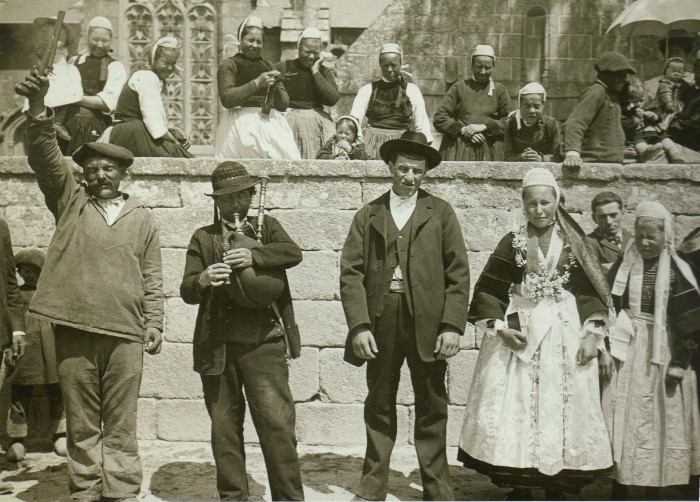
Our inspiration came from this kind of pictures, from wood workers in Central Brittany…
Which means, from a linguistic point of view, it is a language, with its own own specific grammar, syntax and vocabulary, and not a dialect derived from French. Of course, it contains many words derived from French, just like French also has some words from Breton.
.
– 2 – Breton is a Celtic Language
Where French is a Latin language, Breton is from the Celtic branch of Indo-European languages, and is related to Welsh and Cornish (‘P’ Celtic languages) as well as to Irish, Scottish Gaelic and Manx (to a certain extend…).
When we look at old Cornish grammars (the last person speaking fluently the language is said to have died in 1777 – although there are groups of “neo-Cornish-speakers”), it really is very similar to modern Breton.
.
Celtic languages family
– 3 – Breton is a written language
Just because it is not an official language ( it is the only spoken Celtic language that isn’t recognised as an official or regional language), it is not taught in most schools doesn’t mean it can not be written. And indeed it has been written for centuries, The Leyde Manuscript (790) being a well-know example of old Breton.
Last official survey in 2007 indicates that 206000 people in Brittany speak Breton (out of the 4,3 Million inhabitants in the province). In 1999, 61% of them were over 60 years.
More recent sources >here< (in French, but numbers are quite easy to understand 🙂 )
.
– 5 – 14 709 children get education in Breton at school
In 2012-13, 14 709pupils (from age 3-18) get to study in Breton, within 3 systems:
Diwan: private schools with 100% teaching in Breton (except French and foreign languages)
We’ve been hardly focusing on music recently, due to all the events that are happening right now in Turkey. We’ll try to tell you soon a few personal feelings from “the inside”. In the meantime, we are proud, really really proud to read this review about our album in fRoots current issue.
Sometimes I get hoist by my own prejudices and preconceived ideas. So it was that I glanced at the back of this album, noted the legend “A colourful and delicate oriental shine over wild Celtic music”, and the dread vision of Loreeena Newage materialised. And so it festered unplayed in the ‘oh f*** do I really have to listen to this?’ pile on my desk for several weeks, until we were just about to go press with this issue.
Don’t do that at home. Should a copy of this CD appear in your letterbox, hopefully because this review may have alerted you to it, seize it and put it in your player straight away. You will not be disappointed.
For ‘Celtic’, do not read ‘wifty-wafty-synthy-twee’, but instead gloriously full-throated, truly inspiring Breton singing and melodies from Simone Alves. For ‘a colourful and delicate oriental shine’, read ‘roaring, intricate, fiery, imaginative accompaniments’ from multi-instrumentalist Yann Gourvil on oud, electric saz (or baglama as the Turks call it), violin and programmed percussion.
Indeed, for ‘oriental’, don’t read ‘Far East’ as we Brits tend to use it, but ‘from the Eastern reaches of the Mediterranean’. It’s the sort of production that wouldn’t sound out of place on the better contemporary Turkish roots records – it turns out that they’ve lived and studied in Istanbul for the past few years – and it’s obviously a close relative to what Kristi Stassinopoulou & Stathis Kalyviotis did with Greekadelia. In fact I’d christen it Breton-Turkadelia if I hadn’t run out of credit in the ‘name a genre a day’ fund.
When I hit them up for a copy of the biog that this maltreated review copy had obviously got separated from, I found that they were involved in one of the sainted Erik Marchand’s inspiring projects that included Ross Daly, Thierry ‘Titi’ Robin and Keyvan Chemirani. That makes complete sense, and they are justifiably spoken of in the same breath as those iconic names. And if that doesn’t get you people who know about that sort of thing reaching for your credit cards, I don’t know what will.
If we were born Turkish or from some Balkan village, being musicians could have been like that:
.
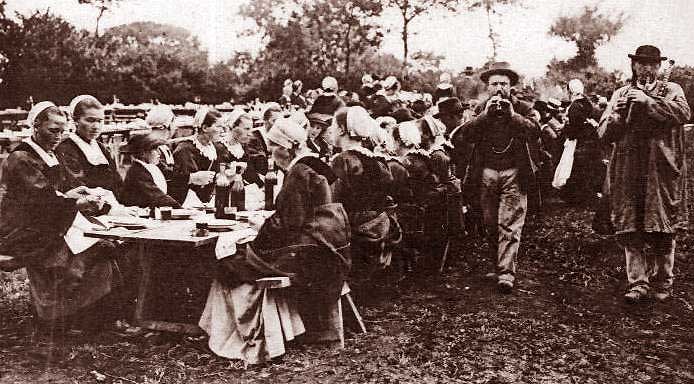
Traditionally, at least if we refer to the last century, musicians had a rôle to play within Breton society. They were the ones present at weddings, for baptism ceremonies, to celebrate harvests, big fairs, departures to the army any major social events, even for elections.
Nowadays, it is more than unusual for people to hire traditional musicians for a wedding. There are meaningful exceptions. But I haven’t heard of any musicians making a living out of wedding playings like it can be in Turkey, or like it used to be in Brittany too. Unless they are DJ’s, or maybe a retro-cover-band?
Although we sing the same songs and tunes, as well as dances as singers used to about 60 years ago, we can’t really say we make the same music. We play for concerts, we play for festivals, we play for videos, we play for recordings. But in most of cases, even in Brittany, we play for people that don’t understand our language.
But… it’s only up to us to find & invent our own Tradition.
.
Until the next generation will take over.
§ Simone
.
41.00527028.976960
Your friends might thank you for letting them know about our music !




 . astrakan project .